
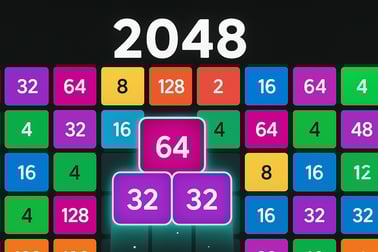
Math Games, where quick thinking meets real fun
Math Games turn everyday numbers into satisfying challenges you can play in your browser, whether you want a calm brain warmup or a fast-paced puzzle. This category brings together arithmetic adventures, logic-driven riddles, and skill-building challenges that make mental math feel natural. Expect short rounds, clear goals, and rewarding progress, with difficulty that scales from beginner-friendly practice to advanced number strategy.
Arithmetic Speed Challenges
If you love the rush of beating the clock, arithmetic speed challenges are the perfect entry point to Math Games. These titles focus on quick addition, subtraction, multiplication, and division, often in bite-sized rounds designed to improve fluency without feeling like homework. Many games use combo scoring, streak bonuses, and gentle difficulty ramps, so you build confidence while staying engaged. A smart approach is to prioritize accuracy first, because clean answers maintain streaks and keep the pace comfortable. Over time, you will start recognizing patterns, like making tens, doubling and halving, and grouping numbers for faster solutions. This subgenre is also great for short sessions, since you can play one round during a break and still feel a measurable sense of progress.
Logic and Number Puzzles
Logic-forward number puzzles reward planning over speed. Think grid-based challenges, equation builders, and pattern recognition puzzles that invite you to test ideas, revise them, and learn from each attempt. These Math Games commonly use constraints, like limited moves, fixed tiles, or target sums, which pushes you to think several steps ahead. A helpful mindset is to treat each attempt like a mini experiment, identify what the puzzle is asking for, then work backwards from the target. Many players find these puzzles satisfying because the solution feels earned, and the skills transfer into better problem solving in daily life. As you play, you will begin to spot classic strategies, such as isolating variables, balancing both sides of an equation, or using elimination to narrow options.
Geometry and Spatial Reasoning
Geometry-based Math Games blend numbers with shapes, angles, and movement. You might rotate pieces to fit a target, estimate angles for precise shots, or calculate area and perimeter to optimize a design. The fun comes from seeing math in motion, where visual reasoning is just as important as calculation. These games naturally strengthen spatial skills, which can support learning in science, design, and coding. For best results, slow down at first and use landmarks: compare angles to right angles, break complex shapes into rectangles and triangles, and estimate before you compute. Over time, your intuition sharpens, and you will feel more confident solving geometry problems because you have practiced the concepts in interactive, low-pressure scenarios.
Fractions, Decimals, and Percent Mastery
Fractions, decimals, and percent games are ideal if you want practical math that shows up everywhere, from shopping to cooking to budgeting. In this subgenre, you might convert between forms, compare values, or combine parts to reach a target. The best Math Games make these concepts click by presenting them visually, like pie slices, progress bars, and number lines, so you can see the relationships instead of memorizing rules. A strong tip is to build anchors: know what 1/2, 1/4, 10%, 25%, and 50% look like, then use those to estimate more complex values. Once you can estimate confidently, exact calculations become easier, faster, and far less stressful.
Word Problems and Real World Scenarios
Word problem games transform reading comprehension into math confidence. Instead of isolated equations, you solve mini stories involving time, distance, money, or resource planning. These Math Games are especially useful because they teach you to translate language into operations, which is where many learners get stuck. The key technique is to underline the goal, identify what information is given, and decide which operation matches the story. Many games also include hints and step-by-step checks, making it easier to learn without frustration. As you improve, you will notice your ability to parse instructions and make decisions gets sharper, which helps far beyond math itself.
However you like to play, this category is built for curiosity and momentum. Explore different Math Games, try new subgenres, and mix quick rounds with deeper puzzles. Play in-browser, test yourself at your own pace, and enjoy the satisfaction that comes from getting a little sharper every session.
FAQs about Math Games
How can I get better at Math Games without feeling rushed?
Start with accuracy-focused modes and slower puzzles, then increase speed only after you can consistently answer correctly. Streaks and timers reward practice, but steady improvement comes from clean fundamentals.
Do these Math Games work on mobile, tablet, and desktop?
Most browser-based Math Games are designed to run on modern phones, tablets, and computers. For the best experience, update your browser and keep only a few tabs open to maintain smooth performance.
What age group are Math Games best for?
Math Games can fit many ages because difficulty varies by title. Younger players often enjoy visual arithmetic and pattern games, while teens and adults may prefer logic puzzles, fractions, and strategy-based number challenges.
What should I do if a game feels laggy or slow?
Close background apps and extra browser tabs, reload the page, and check your internet connection. If available, lower in-game effects or switch to a simpler mode that uses fewer animations.
Which types of Math Games are best for mental math and everyday skills?
For mental math, choose arithmetic speed games and estimation challenges. For everyday skills, focus on fractions, decimals, percents, and word problem scenarios, since they mirror real-life situations.